Knit Flix

Wednesday, July 09, 2014

Gamp warp

The next chapter in the story about the G-A-M-P, Gamp is about warping the loom.

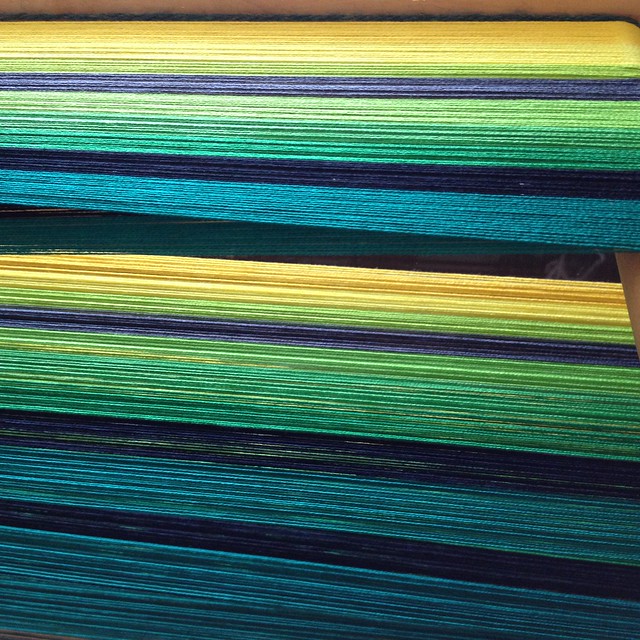
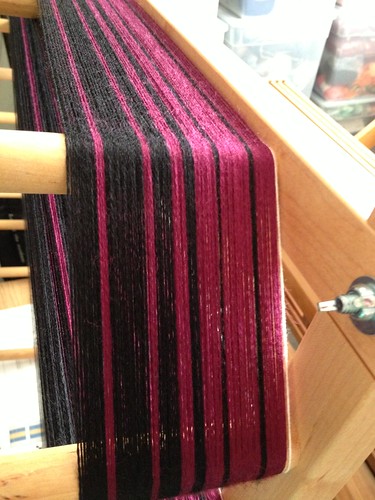
The warp was 5 yards long with 34 ends of each of the 27 colors plus 2 ends at each outer edge for floating selvedges. Let's see... ((27 colors * 34 ends) + 4 floating selvedge ends) * 5 yards = 2.6 miles. Well, that's a good amount of yarn, isn't it? But someone once explained to me that the warp is 1/2 of the project, so once you get the loom dressed, you're 50% finished. That always makes the task sound better to me.
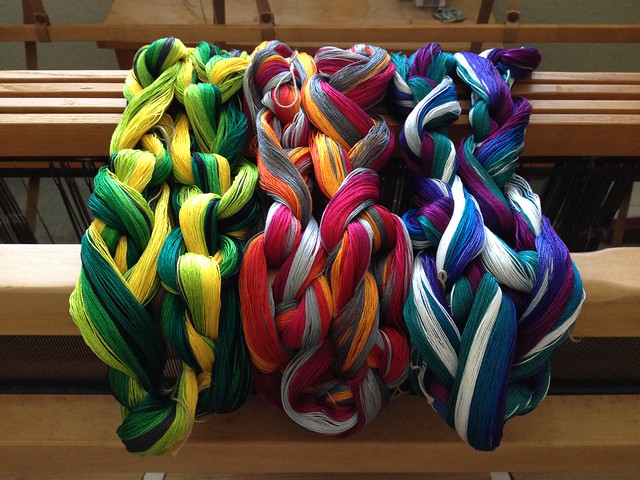

If only it was this easy

I warped the loom from Front to Back using Madelyn van der Hoogt’s instructional video, Warping Your Loom. I find this technique works well for me and it will continue to be my primary method, at least until I get or make a raddle. So I started out with sleying the reed. Looking at the time stamps of these photos, this took me 2 days. Granted this was over Memorial Day weekend so I had another day off to do the mundane household chores, otherwise the elapsed time would have been at least a week.
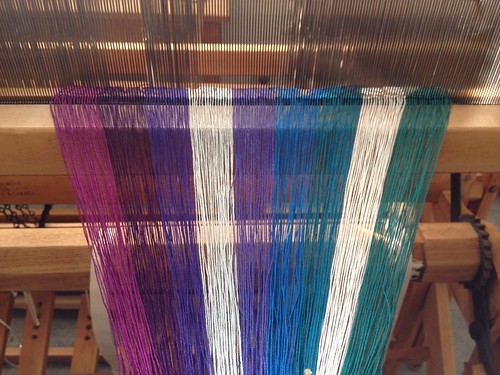

1/3 sleyed
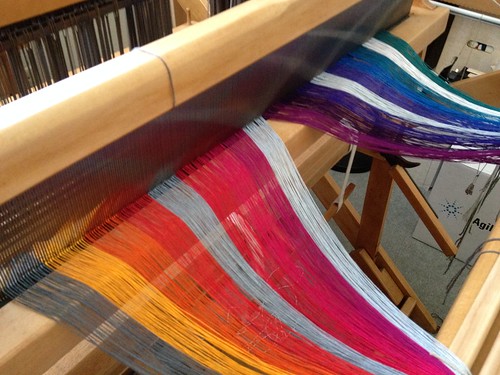

2/3 sleyed
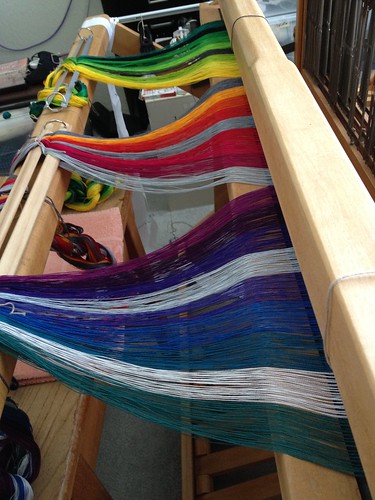

922 ends sleyed

After 2 days of getting all those pesky ends through the reed (12dpi, 2 ends per dent for the weavers in the crowd), it was time to figure out how many heddles I had and make sure I had enough on each frame. I probably should have done that earlier because in the event that I didn't have enough, I would have had to order more. Well, it turned out that I had enough heddles with a few to spare. I redistributed the heddles on the loom so I wouldn't run out on any of the frames and threaded the heddles. I divided each color into 4 groups with 8, 9, 8, and 9 ends each. Each group was double checked for threading errors and then it was knotted.

Again, checking the time stamp of the photo I see that the time elapsed from when I sleyed the reed to when the heddles were threaded was just 1 week. That surprises me, I thought it took longer.
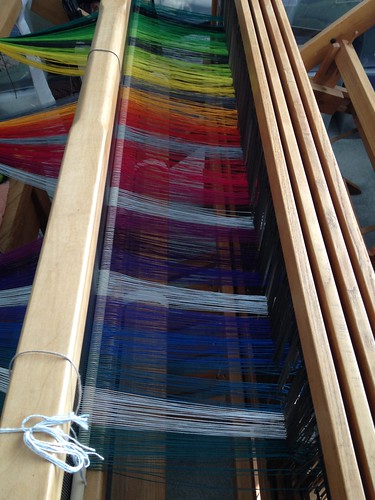

Color gamp warp

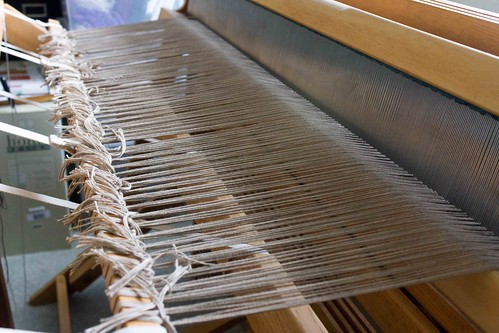
The next step was to tie the ends to the back apron rod and do what's called crank & yank. Funny, huh? You basically turn a crank which pulls the warp threads through the heddles and the reed and winds it onto the back warp beam. It's a slow process because you crank a little bit, then come back to the front and pull on groups of warp threads to even out the tension (yank). After most of the 5 yards is wound onto the back of the loom, the free ends are tied onto the front apron rod.
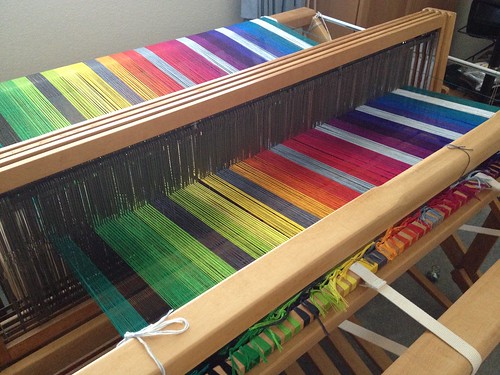

Color gamp warp

Now the loom is dressed and weaving can begin! Actually I consider all of the above weaving, but you know what I'm saying. Once you start weaving cloth, the pattern is visible and you can see if there are mistakes in the warp that need to be fixed. But that's why I checked every group of 8 or 9 warp threads to make absolutely positively sure that there wouldn't be any issues and I could start weaving right away. Well, it didn't turn out that way.

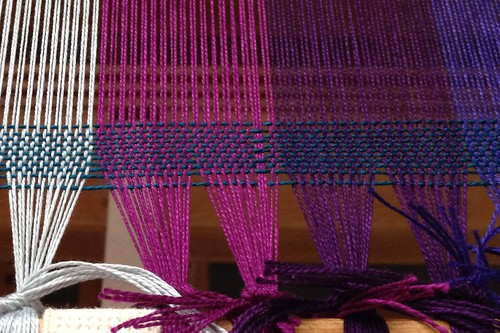
I started with some tabby weave or in other words, just some plain over-under weaving. In the picture below, you can see where there is a threading mistake. There's a group of 3 magenta warp threads that are moving together. What should be happening is the thread in the middle of the group of three should be moving up when the outer two move down, and down when the other 2 move up.

0.1%

It wasn't a huge mistake and it was the only one I found in 922 threads, so that was actually pretty good. Basically, I mistakenly threaded the middle warp thread through a heddle on the wrong frame. To fix it, I had to untie that group of magenta threads from the front apron rod and rethread that one thread through a heddle on the correct frame. The only problem with that was I didn't have a heddle in that position on that frame. Madelyn van der Hoogt to the rescue! In her video, Weaving Well, Madelyn describes how to make a heddle out of string for just this purpose. Done and done.

Here's the fixed warp, the plain weave with hemstitching in blue, and the first color stripe woven in point twill in teal.


Color gamp

I'm finding that getting the right number of picks per inch (density of weft threads) is tricky. If I beat the weft too hard, the weft threads are too close together and the squares of color end up being short fat rectangles. If I don't beat hard enough, the squares end up as tall rectangles. So getting that just right AND having neat selvedges (edges) is my challenge now. I'll weave a color stripe find a number of things wrong with it, then I'll unweave and reweave it. Having a critical eye can be a pain, but some of the issues I've fixed are things I would notice forevermore, so for me it's better to take the time to rework them. With that, you don't need to leave any comments about galloping horses.
Labels: , , , , ,

Sunday, June 29, 2014

She's just a G-A-M-P, GAMP!

Choosing colors for weaving is a challenge for me. Contrast, value, saturation, and hue are terms that I've learned about in various color classes, but there's a certain level of anxiety, fear, and uncertainty that grips me when I need to make my own choices. Perhaps that's why I appreciate kits for stranded and Fair Isle knitting, the work is already done for me.
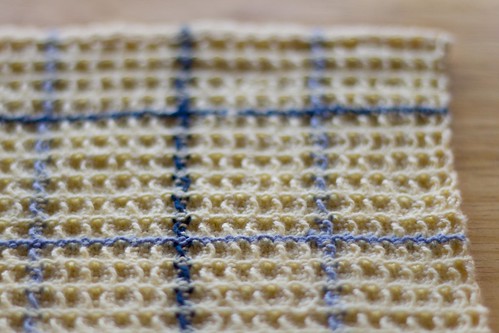
When I started weaving, I ran across the term "gamp" over and over again. A gamp is a woven piece of fabric that illustrates what happens when different weave structures, yarns/fibers, colors, etc., intersect. So a color gamp is a reference piece that shows what different colors look like when they are woven in a fabric. Michele Belson and Katzy Luhring from Lunatic Fringe Yarns go into detail about color gamps in this Weavezine article.

Think of your color printer--you have only 4 ink cartridges: yellow, magenta, cyan, and black. But somehow the combination of those colors on the printed page can produce seemingly endless number of colors. What color we see depends on how much of each ink is used and how it is placed (in what pattern). It's pretty amazing when you think about how we perceive color.
Anyway, back to weaving. The color gamps I found online have warps of uniform stripes in different colors. Then the weft is woven in stripes of the same colors, in the same order. So every color in the warp will intersect with every color in the weft and the blocks along a diagonal will be solid blocks of color, where the warp and weft colors are the same. With this fabric, you'll be able to see what purple warp and yellow weft look like together. It may or may not sound like a good combination, but the color gamp will show you. Another consideration for a color gamp is the weave structure. That purple warp and yellow weft block will look different in a plain weave, a twill, or an overshot pattern. So weaving a color gamp in different weave structures would be a good idea.

It sounds like a lot of work for a color/weave structure reference, doesn't it? But I don't consider weaving with beautiful yarn to be work... but it is a lot of effort and time. That's okay, I'm learning and discovering as I go and besides that, the fabric is quite beautiful. All in all, weaving can be a very rewarding experience.

I went to the Conference of Northern California Handweavers in Oakland this year and headed straight to Lunatic Fringe Yarns booth. They have color gamp kits available on their web site and I wanted to see samples of the woven gamps in person before making the investment. Well, the gamps were really beautiful and I was able to see them in thicker and thinner cotton and also talk to them about the color gamp kit vs. the color gamp kit plus white, black, and shades of gray. All in all, I felt much better about seeing the product in person first and actually bought the Tubular Spectrum Plus Kit--spectrum colors plus white, black, and shades of gray.

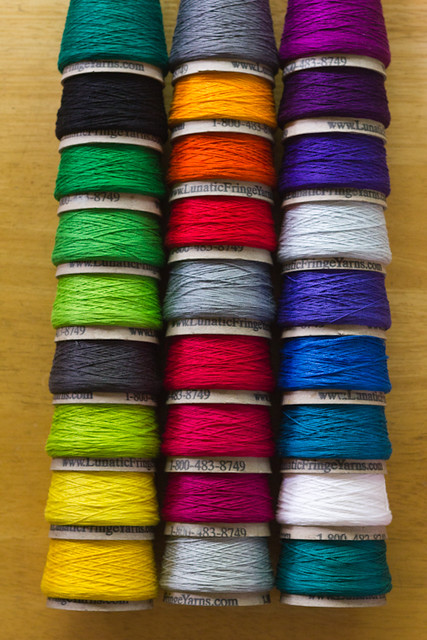
The kit came with instructions for weaving on a 4-shaft or 8-shaft loom, including a suggested color order. Well, I decided to go off course immediately and put the colors in a different order. I asked for feedback from the 4-Shaft Weaving group on Facebook and with their excellent input, finalized on this:


Lunatic Fringe Color Gamp

The order starts in the lower left corner and goes up each column, ending with the upper right corner.

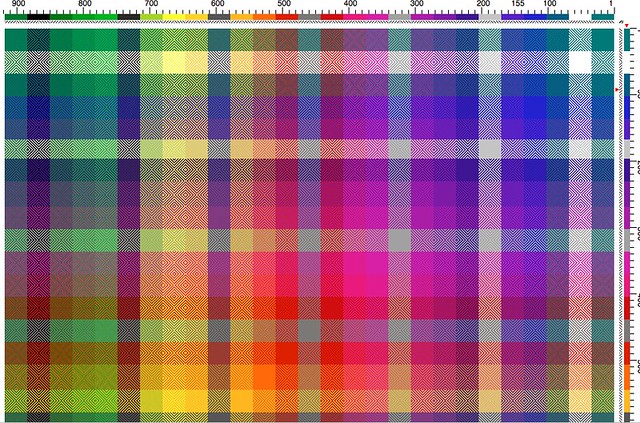
I decided to start with a point twill and entered the colors and design into Fiberworks to see how it would look.


Color Gamp in Fiberworks

You can't see all of the rows in this screenshot, but you get the idea. Pleased with how it looked on screen, I planned the rest of the project in a spreadsheet and the next step was to wind the warp.

It was at this point that I had to stop and find some courage. This project was going to require 922 warp threads and 27 colors in a relatively thin cotton. The width in the reed was going to be over 36". This was easily the largest project I had ever attempted. I took a deep breath (for a few days) and finally go started warping.


Warp chain 3 of 3

After I warped a couple of colors, I revisited my spreadsheet and realized that I didn't calculate enough warp length. So I had to take those colors off the warping board and add an extra yard. At least I found the problem early... it wasn't too painful to fix.


If only it was this easy

The warp chains were so pretty I couldn't wait to dress the loom, but 922 ends was going to take a while. As motivated as I was to get warp the loom, I had to be patient and work carefully so I didn't make any mistakes.

Next up: The Warp

Labels: , , , , ,

Wednesday, May 28, 2014

So say the judges

The judges' scorecards are in and here are the results for my entries in this year's California State Fair -- booyah!

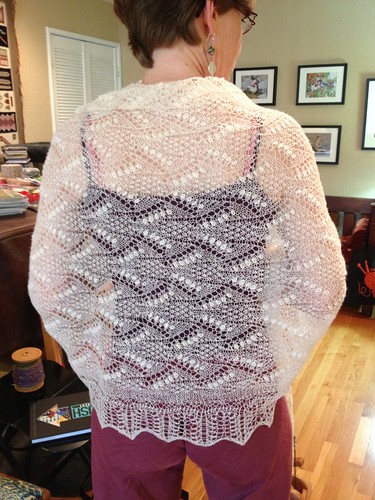
  • Wind on a Wheat Field Haapsalu Shawl

    Wind on a Wheat Field
    Project details on Ravelry
    2nd Place, Division: Knitting,
    Class: Knitted Wearing Apparel

    Judge's Comments: Lovely, lacy design. Border adds to overall design. Piece shows good tension and attention to blocking. Well-done [sic].


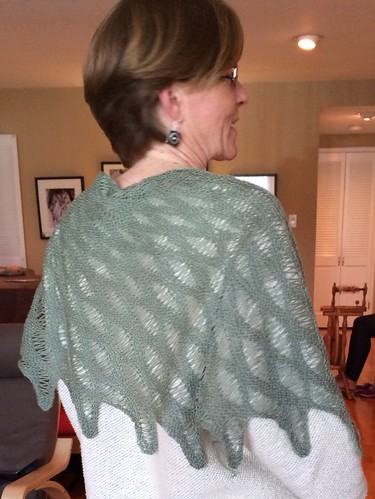
  • Mixed Tide Shawl - original design

    Mixed Tide shawl
    Porject Details on Ravelry
    Honorable Mention, Division: Knitting,
    Class: Knitted Wearing Apparel

    Judge's Comments: Good color choice for a "tide" pattern. Better blocking would "show off" pattern more clearly. Well done for a challenging technique.


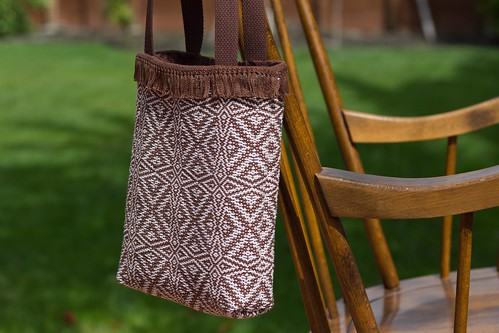
  • Crackle Sac

    Crackle Sac
    Project Details on Ravelry
    2nd Place, Division: Other Fiber Art,
    Class: Any Other Fiber Art

    Workmanship: 20
    Level of Difficulty: 19
    Design: 19
    Appropriate Pattern or Technique: 19
    Creative use of materials or fabric: 18
    Judge's Comments: Very good job! Weaving, making bag, matching pattern on seams! Well done.


  • Merino, Baby Camel, Silk Handspun Yarn

    Lisa Souza Merino, Baby Camel, Silk Top 2-ply handspun
    Project Details on Ravelry
    Honorable Mention, Division: Other Fiber Art,
    Class: Any Other Fiber Art

    Workmanship: 19
    Level of Difficulty: 18
    Design: 17
    Appropriate Pattern or Technique: 17
    Creative use of materials or fabric: 18
    Judge's Comments: Luscious hand to this yarn--nice job!


Labels: , , , , , , , , , , , , , , , , , ,

Tuesday, May 06, 2014

Going to the fair

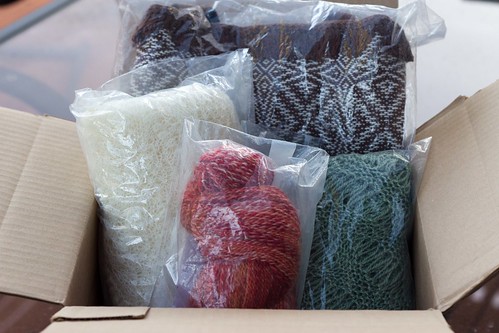
My entries for the California State Fair are packed and ready to go to Sacramento.


Going to the fair

Here's what they look like out of their plastic bags--


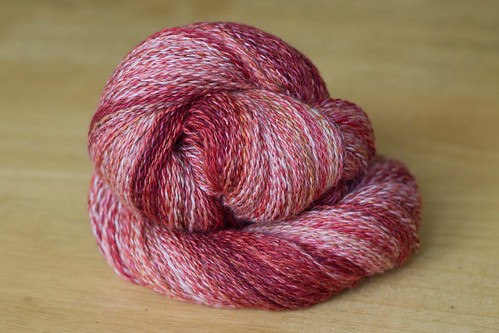
Lisa Souza Merino, Baby Camel, Silk Top 2-ply handspun


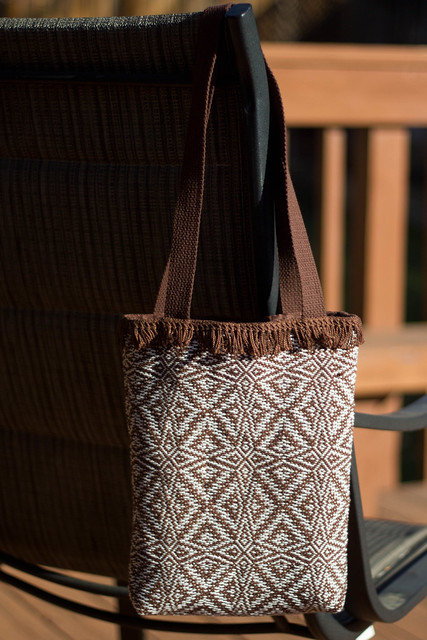
Crackle Sac


Wind on a Wheat Field


Mixed Tide shawl

Per my previous experience, I have no idea how these pieces will do so I'm trying not to get my hopes up. I'll let you know what the results are later this month. Wish me luck!

Labels: , , , , , , , , , , , , , , , , , ,

Sunday, March 30, 2014

Crackle Sac 2

I finished the second Crackle Sac today. The weaving was actually finished 7 weeks ago. I don't know why I waited so long to sew the lining and put it all together, but it's done now. The 3rd is on the loom with only 2 pattern repeats to go. At this rate, it'll be finished this summer.


Crackle Sac 2
Project details on Ravelry


Labels: , , , , ,

Friday, January 10, 2014

The Crackle Sac

I love how that sounds, "The Crackle Sac".

So what is a Crackle Sac? It's what I call this little ditty:

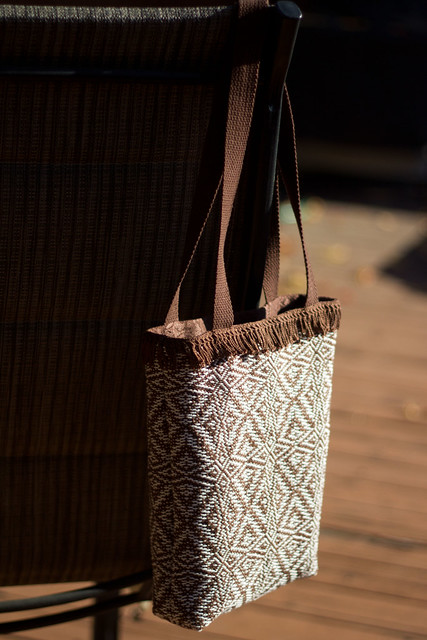
Crackle Sac
Crackle Sac

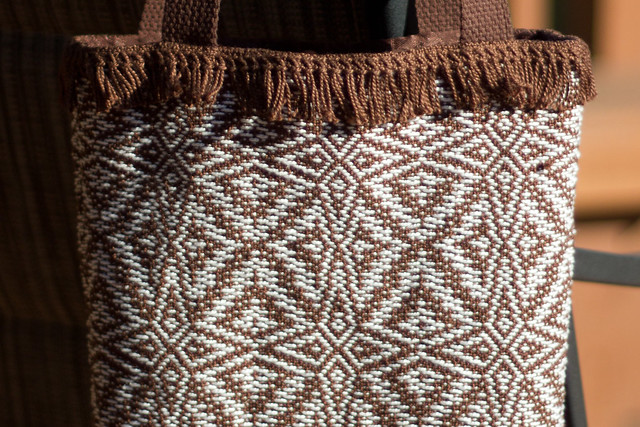
The bag is 5/2 cotton from WEBS woven in a pseudo crackle weave. Now, I can't tell you why it's pseudo crackle and not real crackle, I'm just going by what more experienced weavers tell me.

Crackle Sac

The beginning and end of the fabric was hem stitched, so the fringe is the warp.

Crackle Sac

7 repeats of the pattern created a single woven piece of fabric about 10-1/2” wide and 25-1/4” long after hand washing. I sewed the edges together and boxed the corners.

Crackle Sac

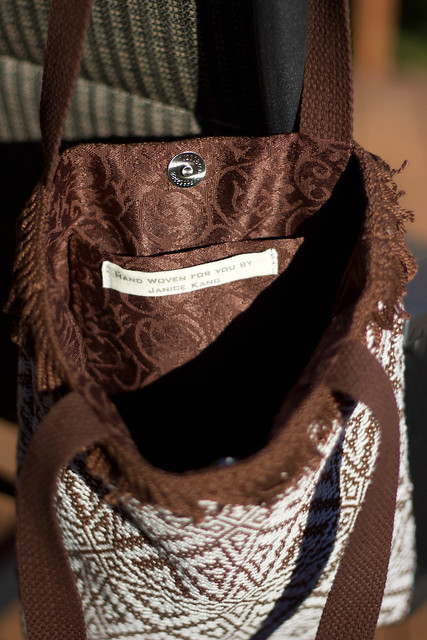
It's fully lined and has a magnetic closure. The label was an afterthought that I printed on my injet printer. Printing that little piece of fabric and finishing the edges was a pain! After that experience, I quickly placed an order for personalized labels. Yeah, I can make intricately designed fabric out of string, but I draw the line at making a label. Everyone has their limits.

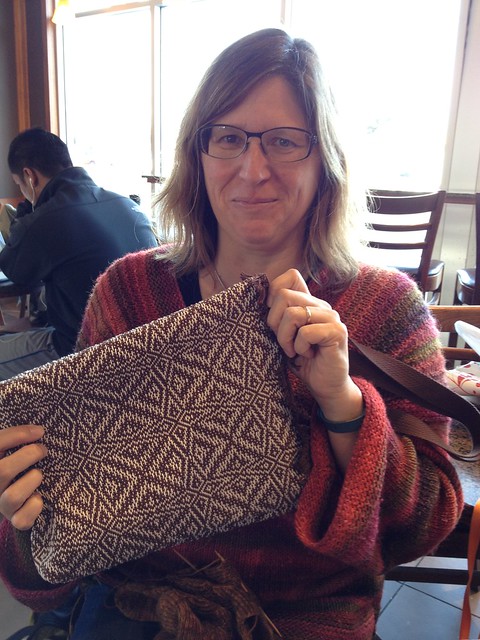
Today I gave the Crackle Sac to my dear friend, Spinnity. She looks pretty happy, don't you think?

She likes it!
She likes it!

Spinnity let me know that it's our 10th Knitting Friend-o-versary. Oh my goodness, 10 years already? Time flies when you're having fun, that's for sure. She also had a gift for me and I'll share that with you in a future blog post.

The Crackle Sac. I'm pleased with how it turned out and am overjoyed that it is with its new owner. Enjoy!

Labels: , , , , , ,

Wednesday, May 15, 2013

Why didn't anyone tell me??

I read the discussion boards on Ravelry regularly and there are so many times when I think that the person's question could be answered if they just created a swatch and washed it. "Just do it," says my inner voice, "because how can I know how the fabric you create will or won't change with blocking? Make a swatch and wash it."

Yes, swatching & washing in knitting can answer a lot of questions before umpteen hours are invested in the real project.

But this post isn't about knitting, it's about weaving. Have I mentioned that I've never "sampled" in weaving? Sampling is the weaver's equivalent to swatching. Oh no, I've just warped and wove. But if I sampled, maybe that chenille "scarf" wouldn't have ended up as dense and as stiff as new denim. It could have been upholstery fabric if it was wider. Instead, I made it into a yoga mat bag.

I found a bead leno scarf project in a Handwoven ebook that looked interesting. Bead leno doesn't refer to beads that are woven into the fabric, rather the beads are used to redirect warp threads when certain treadles are pressed. The warp threads twist, the weft is passed through the warp, and the twist becomes part of the fabric. It sounded intriguing and not completely out of my league, so I dove in the stash and found yarn for it.

The yarn used in the ebook project was a sport weight yarn, but I wanted to use Colrain Lace, a 50-50 Merino Tencel yarn that I bought at Stitches West 2012. I asked for guidance from the 4-shaft weaving group on Facebook for a sett to start with. They suggested trying 12 epi, but to be prepared to re-sley if I didn't like the fabric. That's what I planned for, 12 epi. The warp length in the project allowed for sampling. I thought I'd throw a few picks, get a feel for the project, then start weaving. Certainly I wouldn't have to cut the sample off and wash it because really, how much would it change?

Happily, I prepared a 5 yard warp of 120 ends. Everything went relatively quickly compared to my last projects that had 500+ ends.

Striped warp
Striped warp

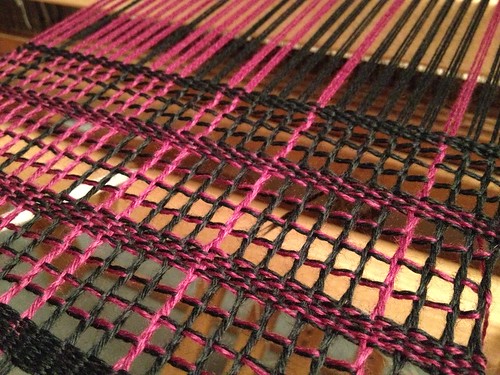
The beads were put in place and I was ready to start. But once I started weaving my sample, I was shocked. This didn't look like lace, it looked like a fish net! Ugh, this was not the look I expected. Maybe I needed to re-sley at 16 epi? Maybe I needed change my approach completely, take the beads out and go with a 4-3-2-1 twill?

Bead Leno sample
Bead Leno sample

Maybe it was me. Maybe I wasn't open to change. I knew twill, but I didn't know lace. Maybe this would be okay as-is. It didn't have to look like every other thing I made. To get some reassurance, I posted the photo in the weaving group to get feedback.

The comments I received were positive, but there were 2 comments that made me think that there was more to this than met the eye--

Margaret said, "It looks like Leno to me."

I thought, "Really? So this is what leno looks like on the loom? But it doesn't look like the project in the ebook."

Su said, "I like the look of the leno and will be anxious to see what happens off the loom and after wet finishing. I think it will be beautiful!"

Wait a second. Something happens in the wet finishing process. This wasn't the end product! I needed to take the fabric through the final process so it could become what it's suppose to be.

Gee, does that sound familiar? MAKE A SWATCH AND WASH IT. Well that's exactly what I did last night. I finished the sample and gave it a bath in Eucalan.

Why didn't anyone tell me??

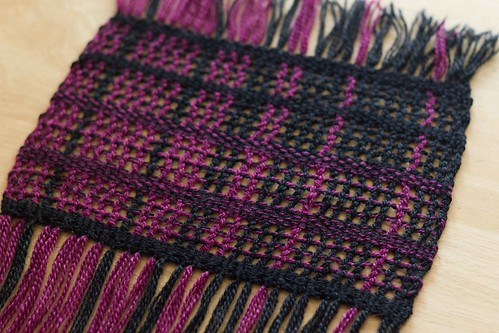
Bead Leno sample after wet finishing
Project details on Ravelry

Labels: , , , , , , ,

Friday, December 28, 2012

Goose eye and ladders

I started to weave the next set of goose eye towels. The warp and weft are Valley Yarns 8/2 cotton from WEBS.

Goose eye
Goose eye

After I wove the stripes, I switched gears and made a ladder bracelet. Being able to start and finish a piece in one sitting is a new experience and it's very rewarding.

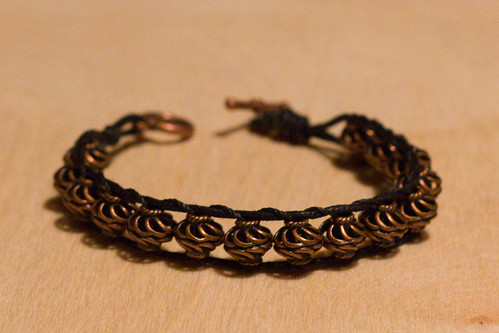
Ladder bracelet
Ladder bracelet

Labels: , , , , , ,

Wednesday, December 26, 2012

Gifted, tied on, and something new

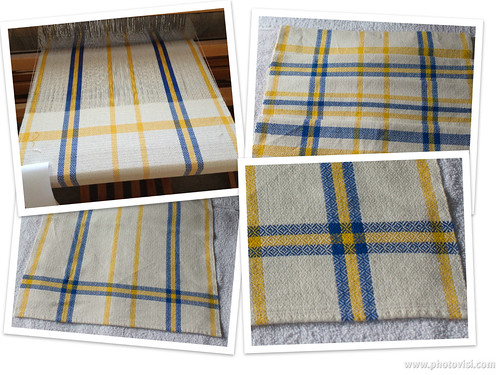
Well, the Anna Towels were cut off the loom, hemmed, and gifted. What a success!

Anna Towels
Anna Towels

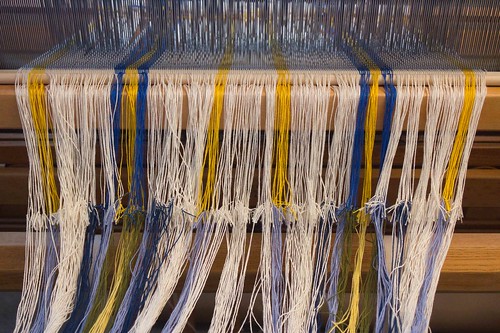
But before cutting them off, I inserted lease sticks to keep the 2 ends per dent in their proper order.

The end of the warp
The end of the warp

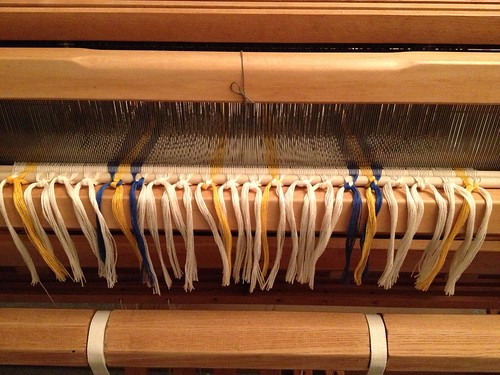
Mutareposts showed me how to tie a weavers knot and I finished tying on a new warp today.

Old warp, new warp
Old warp, new warp

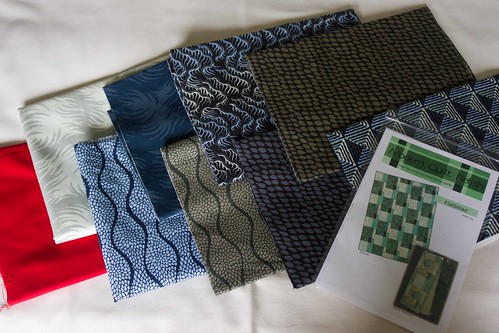
Before Christmas, R and I went to a new local quilting shop called The Intrepid Thread. The owner has had an online presence for years and her retail shop just opened this month. I picked out a pattern and fabric for a quilted throw. Quilting?? Sure, why not?

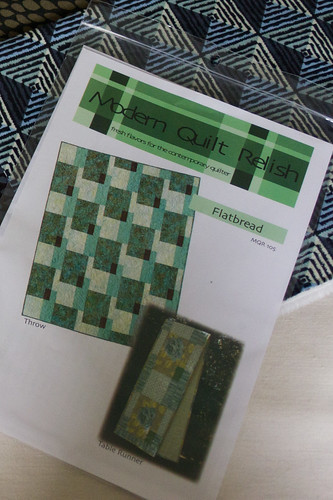
Here's the pattern:

Flatbread
Flatbread

And here's the start of the quilting stash.

A new adventure
A new adventure

From left to right: The red will be the small dark rectangles, the light fabric will be the light color, the blue fabric that is 3rd from the left will be the narrow teal blocks, and the remaining 6 fabrics will be large medium green blocks.

Labels: , , , , , ,

Sunday, November 04, 2012

The end of the warp

How wonderful to look through the reed and see the end of the warp approaching the heddles.

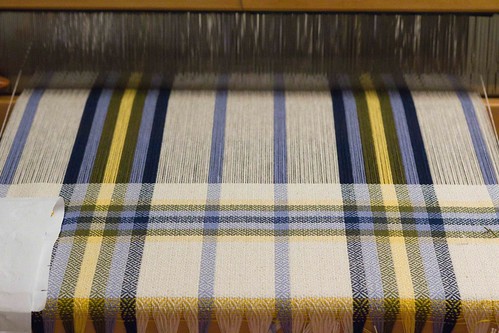
1-2-3-2 Stripes
1-2-3-2 Stripes
Project details on Ravelry


The 1-2-3-2 Stripes fabric is finished, all 4 yards of it. Whew! I hemstitched this end, then went back to the beginning and hemstitched it, because I forgot to when I started the project.

This fabric will be cushions for a rocking chair. It's essentially upholstery fabric, so I wasn't planning on washing it before I cut and sewed it. What do you think? Will that be okay or do you think it would be better if I put it through a gentle cycle in the washer & dryer? It's 100% cotton.

Regardless, I'm counting it as a FO now.

Labels: , , , , , ,

Sunday, February 12, 2012

Plan B for 1-2-3-2

My next weaving project was going to be Krokbragd fabric. Krokbragd is a 3-shaft weft-faced weave structure from Scandinavia. The threading and treadling pattern is always the same, so the patterning is achieved by changing weft color, similar to stranded knitting.

Here's a site with examples of Krokbragd--check out the sheep in the 3rd photo from the top. Amazing!

I thought that the firm fabric would be perfect to make new cushions for my rocking chair. Well, I worked out the project dimensions and warped the loom. However, when I started weaving I could not get the weft threads to pack down the way they needed to for the weave structure. I posted a question on the newly formed FB group for 4-shaft weavers and they confirmed that a thinner weft yarn would be more appropriate.

Darn it.

My loom was committed to a 1-2-3-2 threading. I turned to the internet. I did a search on Handweaving.net and in no time I had a handful of drafts for the same threading.

After a little sampling, I had my Plan B.

www.Handweaving.net Draft #45336 4 sur 8, Planche A, No. 73, P. Falcot: Traité Encyclopedique et Méthodique de la Fabrication Des Tissus, ca 1844, France, 3 shafts, 3 treadles
www.Handweaving.net Draft #45336 4 sur 8, Planche A, No. 73
P. Falcot: Traité Encyclopedique et Méthodique de la Fabrication Des Tissus, ca 1844, France


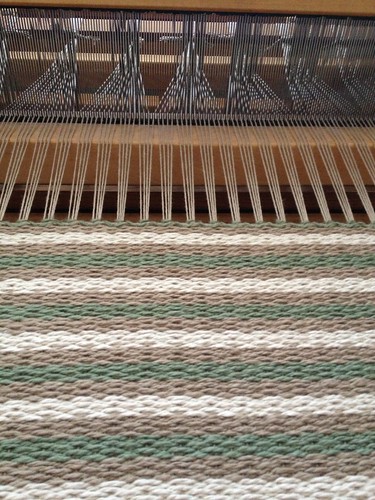
The actual woven fabric below doesn't show the pattern as clearly as the draft because of the carpet warp vs. the worsted weft, but I really like the texture.

1-2-3-2 stripes
1-2-3-2 stripes
Project details on Ravelry

Thank goodness for Draft Search on Handweaving.net. Sure, I could have looked in my weaving books, but the site allowed me to search over 50 books/collections of drafts very quickly.

Labels: , , ,

Saturday, January 14, 2012

Saturday snapshots

It's in the rotation
Project details on Ravelry


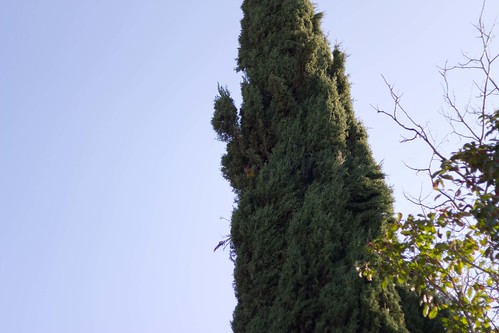
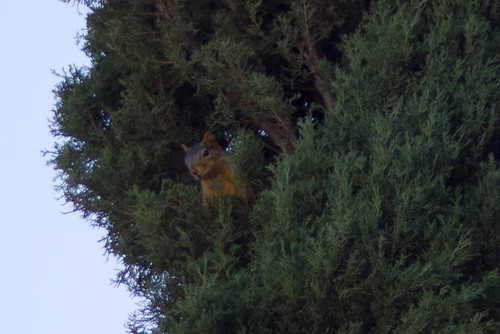
Italian Cypress Villa

Who's that peeking out up there? I should have known. :(

The Penthouse
The Penthouse

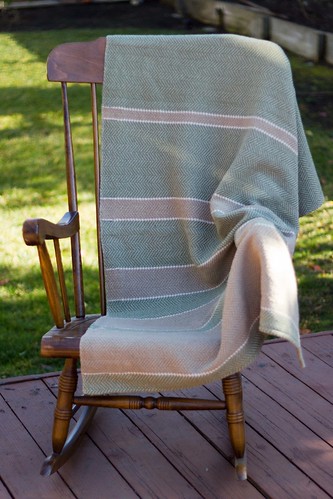
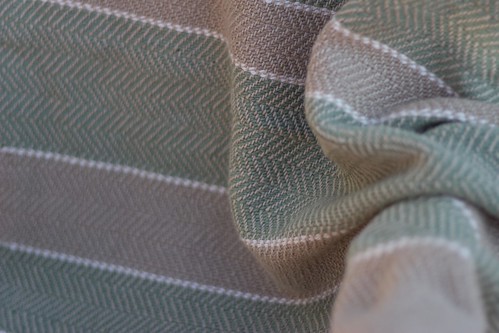
I can show the next project now that it has been gifted. It's 100% cotton woven in an 8 pick herringbone Fibonacci sequence. It's my first FO for 2012.

Herringbone Sequence

Herringbone Sequence
Project details on Ravelry

Labels: , , , , ,

Thursday, January 05, 2012

Finishing WIPs... later

I hope to finish all of my languishing WIPs in 2012, so can you guess what I did this week?

Ding! Ding! Ding! That's right, I started a new project! Those WIPs will just have to wait.

New Year's Day 2012

Labels: , ,

Sunday, January 01, 2012

New Year's Day 2012

New Year's Day 2012

New Year's Day 2012

New Year's Day 2012

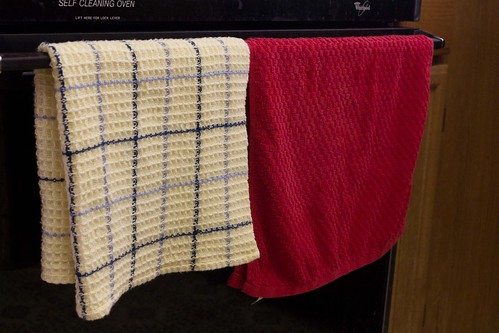
Honeycomb towels

Honeycomb towels
Honeycomb towels
Project details on Ravelry


The Honeycomb towels took a trip through the washer and dryer and they're GREAT! They shrank beautifully and are really soft. I was worried that the towel body wouldn't shrink at the same rate as hem, but it did. Success.

Happy New Year!

Labels: , , , , , , ,